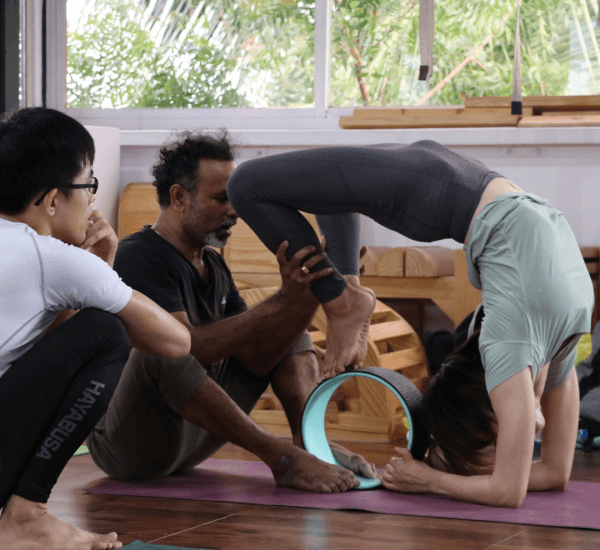
300-Hour Yoga Teacher Training Course, Mysore
karnataka
30D
About this experience
This 300-Hour Yoga Teacher Training course, certified by Yoga Alliance USA, is an excellent opportunity for those who wish to deepen their practice and enhance their Yogic knowledge while refining their teaching skills.
Throughout the course, a strong emphasis is placed on key alignment principles and anatomical structures of various asanas, ensuring that you become a practitioner and teacher who understands and teaches yoga with a focus on safety.
You will also explore advanced techniques in Meditation, Pranayama, and Yoga Philosophy, transforming you into a dedicated Sadhaka and yoga professional, enriched with mindfulness and a deep, authentic understanding of the Yogic lifestyle.
Day-by-Day Itinerary
2
DAILY SCHEDULE:
• 5:30 - 7:00 AM: Ashtanga Intermediate / Kriya + Ashtanga Primary
• 7:30 - 8:30 AM: Medical Pranayama
• 9:00 - 10:00 AM: Breakfast
• 10:00 - 11:00 AM: Anatomy / Therapeutic Ayurveda
• 11:00 - 12:00 PM: Yoga Philosophy
• 12:30 - 2:30 PM: Methodology
• 2:30 - 3:30 PM: Lunch
• 4:30 - 5:30 PM: Meditation
• 5:45 - 7:15 PM: Hatha Masterclass
• 7:15 - 8:15 PM: Pathophysiology & IAYT
NOTE: The schedule may be adjusted depending on the situation.
COURSE OVERVIEW:
• Ashtanga Yoga
Being located in Mysore, known as the Ashtanga yoga capital of the world, Yoga with Srinatha offers authentic Mysore-style Ashtanga Yoga in the 300-hour Yoga Teacher Training. Our Ashtanga teachers are dedicated sadhakas (practitioners) who teach with the sole objective of delivering an authentic experience based on ancient texts and techniques. In this course, you will learn a creative and intelligent series incorporating the use of bandhas, drishti, and proper alignment.
• Hatha Yoga
Hatha Yoga was introduced to the Western audience by Indian gurus in the mid-19th century. Traditionally, it is defined as the means of attaining a state of yoga through force (hatha). It involves cultivating physical health and mental well-being through a series of postures, pranayama, and dhyana. These practices help achieve balance between body and mind, or the sun and moon. In the RYT 300 course, we honor the essence of Hatha Yoga by focusing on bringing proper balance, stability, flexibility, and strength to our students. We also emphasize teaching students how to relax in a pose rather than merely striving to reach the final position.
• Pranayama
Prana means life and Yama means control. Pranayama, the practice of breath control, involves various breathing techniques, including Nadi Shodhana, Sitali, Ujjayi, Kapalabhati, Bhastrika, Bhramari, Anuloma Viloma, and Sheetkari. We explore the science of yogic breathing, emphasizing the importance of conscious, quality breathing. Since taking a breath is the first and last action every living being performs, it is essential to cultivate consciousness of our breath and its impact on health and well-being.
• Teaching Methodology
Teaching methodology focuses on honing the skills required to become a yoga teacher, combining both theoretical and practical knowledge gained during the teacher training course. At Yoga with Srinatha, students learn essential teaching skills such as group dynamics, time management, and the establishment of priorities and boundaries in the classroom.
• Yoga Anatomy
Yoga anatomy has become an invaluable resource for yoga practitioners around the world, enhancing their understanding of the interaction between muscles, joints, the nervous system, movement, and breath in a pose. This knowledge helps practitioners develop awareness about how to practice safely and injury-free according to their body type, enabling them to enhance their practice while preventing harm.
• Yoga Philosophy
Gain a profound and liberating understanding of the history and philosophy of yoga and Vedanta. This exploration transforms your fundamental relationship with life, leading to greater happiness, deep and lasting contentment, vitality in both body and mind, and peace that manifests not only within yourself but also in your interactions with the world around you.
• Meditation
Meditation is not simply ordinary concentration; it is a special type of internal concentration. Each path of sadhana (spiritual practice) begins in a different way, and every path includes a stage that corresponds to meditation. In Patanjali’s Yoga Sutras, meditation begins with the purification of the mind, posture, and breath control, followed by the withdrawal of the mind from external objects (pratyahara), and the fixing of the mind at a particular center (dharana). This leads to the ultimate state of meditation (dhyana).
• Ayurveda
Ayurveda has a history spanning over 5,000 years and originated in India. It was developed to help individuals achieve a healthy body and mind through Ayurvedic cooking, lifestyle practices, and healing techniques. Ayurveda focuses on prevention, healing, and overall health care, with its foundation based on the five elements known as the Panchamahabhutas (earth, water, fire, air, and ether). These elements form the basis of Ayurvedic philosophy and its approach to holistic wellness.
What's included
1. Food and Accomodation (If opted with pricing)
2. Course Material
3. Certification
Additional information
Duration:30D
₹1,10,000per person
Book with ₹10,000
Upcoming Dates
Free cancellation
Reserve now, pay later
Instant confirmation
You won't be charged yet